Your Cart is Empty



View other products by Sonuscore

The Scale of a Scoring Stage. The Detail of a Real Performance.
LUX Orchestral Strings brings the warmth, power, and expressive detail of a 70-piece symphonic string ensemble into your compositions. Recorded on a large scoring stage, it captures not just the instruments, but the resonance and interaction that give a live orchestra its depth. From intimate, whispering phrases to sweeping cinematic themes, LUX is designed to keep the performance alive as your music develops.
Created by composers for composers, LUX combines detailed orchestral recordings with performance-focused tools for shaping phrases, changing articulations, and building arrangements. Sketch an idea with a balanced ensemble, develop individual parts, and move between textures without losing the momentum of writing.
Highlights
A Full 70-Player String Ensemble
LUX captures the scale of a full symphonic string section rather than a small chamber group or reduced studio ensemble. Its 70-player configuration balances the richness and weight associated with classic Hollywood scoring with the clarity and flexibility needed for contemporary production. Large melodic lines have room to soar, while quieter passages retain the detail that makes an arrangement feel human.
The traditional symphonic seating and concert-hall recording preserve a natural orchestral balance. A wide dynamic range takes performances from delicate ppp textures to forceful fff passages and beyond, giving you room to shape both intimate cues and full-scale dramatic moments.
Seamless Articulation Transitioning
Real string players can change technique without stopping a phrase. A sustained note can become a tremolo as the bow accelerates, with no new attack interrupting the line. LUX's Seamless Articulation Transitioning, or S.A.T., brings that continuity into the instrument, letting you move between articulations while holding a note.
The strength of your keyswitch performance shapes the transition. A gentle keyswitch produces a gradual change, while a stronger one creates a quicker shift. This makes changes of technique part of the musical gesture instead of a break between separate recordings.
Morphing Articulations in Real Time
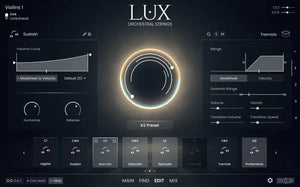
Use the mod wheel to blend between two or more articulations as you play. Sustains can move into tremolos, sul ponticello textures can develop into shimmering atmospheres, and short articulations can change character within a single gesture. These evolving combinations let you shape motion and intensity directly from the keyboard.
The library includes both short and long articulation morphs. Combinations such as staccato to marcato, pizzicato to Bartok pizzicato, and sustain to tremolo offer ways to develop familiar orchestral sounds into more fluid, expressive phrases.
Natural String Change and Adaptive Legato
When a string player crosses from one string to another, the previous string can continue resonating briefly beneath the next note. Developed by violinist and developer Jonas Meyer, Natural String Change technology detects when the next note would fall on a different string and allows that lingering resonance to carry into the transition.
This detail gives wide intervals and arpeggiated figures a more natural connection. Adaptive legato responds to your playing for expressive phrasing, while the available legato palette includes lyrical, whisper, runs, portamento, and harmonics techniques, depending on the section and articulation.
The Resonance of a Complete Scoring Stage
The sessions used 48 microphones in total. Twenty-six captured the main string sound through tree, far, and close positions, while another 22 close bleed microphones were placed across the brass, woodwind, and percussion sections to capture the strings' natural spill into the wider orchestral recording setup.
Close, Decca, and Far perspectives are joined by a dedicated Bleed option. Adjust the amount of spill to add a subtle sense of space or bring more of the full scoring-stage character into your mix. Rather than treating the room as an added effect, LUX gives you access to the recorded resonance and interplay of the orchestra itself.
Composer-Crafted Ensembles
Carefully balanced ensemble instruments help turn an idea into an orchestral sketch quickly. Play soaring melodies, driving rhythms, or supporting layers, then refine the arrangement into individual parts when you are ready. Flexible voicing and octave options let you shape a full string sound without interrupting the writing process.
The ensemble instrument includes polyphonic legato for connected, playable orchestrations. It is equally useful for finding the direction of a new cue and building a broad foundation beneath more detailed section writing.
Key Switch Sets for Your Musical Context
Dedicated Key Switch sets bring together articulations suited to specific scoring tasks. Load a set for an action sequence, lyrical theme, soft texture, or melodic passage, and keep relevant playing techniques together while you compose. Articulation pages support up to 24 keyswitches in a single patch, helping you organize a detailed performance within one instrument.
From Essential Techniques to Unusual Textures
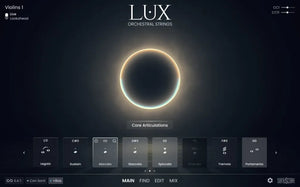
The core articulation palette includes staccato, spiccato, marcato, tremolo, pizzicato, portamento, con sordino emulation, and more. Fluid staccatos were recorded in rhythmic contexts, with an intelligent staccato mode designed for playable ostinatos.
Extended techniques broaden the expressive range with whisper sustains, harmonics legato, soft interval trills, pendulum glissandi, slow bends, and swarm textures. Live-recorded trill figures, measured arpeggios, and performance gestures add movement and realism beyond isolated notes. Polyphonic aftertouch and the added-octave feature provide further performance control throughout the instrument.
Recorded with Care at Every Stage
Sonuscore collaborated with StarRecordings productions and award-winning score mixer Peter Fuchs to capture the ensemble. The sessions used professional microphones from makers including DPA, Schoeps, Neumann, and Coles, preserving the detail of bow strokes, resonances, and subtle playing techniques.
The recording approach supports both the scale of a large string ensemble and the precision of delicate articulations such as whisper legato. The result is a library built around expressive playing, natural room character, and a practical composing workflow.
Expanded with Update 1.1
The free 1.1 update adds new recordings, additional articulations, and improvements to playability and workflow, extending the library's creative range.
Strings for Every Story
Build the pulse of an action cue, the warmth of a romantic theme, or the unease of a suspense passage. Whisper legato and harmonic layers support intimate writing, lyrical legato gives melodies room to sing, and evolving textures open the door to fantasy and horror scoring. LUX Orchestral Strings brings these contrasts together in a performance-centered instrument that moves from the first sketch to detailed orchestral expression.
Windows
Mac
for all
SUPPORTED INTERFACES
Product activation: