Your Cart is Empty


View other products by Softube

Precision loudness & transparency.
You want a loud mix? You need a fast limiter. But you don't want to end up with a clipper with a lot of distortion. To get a loud and transparent mix, the peak suppression type and release method need to be tailored to the music, and while no single peak suppression approach works for all types of music, most limiters use only a single peak suppression method. Enter Limit Pro.
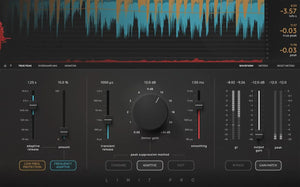
Limit Pro delivers maximum loudness and ultimate transparency by giving you extensive control over peak suppression, metering, and precise and flexible limiting for mastering, mixing, and single tracks. The three peak suppression methods – with frequency-adaptive control of release times – are fit for a variety of genres and music styles. The Low Frequency Protection algorithm keeps the bass intact, and Limit Pro also offers a Gain Match feature, delta monitoring, and gives you a good overview of the metering needed – such as true peak, peak, LUFS, loudness loss, distortion metering for desired transparency, and a real-time peak suppression view. All with low latency, low CPU usage, and the included Limit Go plug-in.
The Art of Rock & Roll Science
Over several decades of partnering with brands like Weiss Engineering, Tube-Tech, Solid State Logic, Chandler Limited, and Trident, we’ve built a rock-solid reputation for creating equipment that improves your workflow and gives you superior sound quality.
We built Limit Pro & Limit Go on this foundation. One of creativity, passion, and attention to detail. Because, to create tools that innovate, you have to have heart, soul, and Rock & Roll Science.
Pick Your Peak Suppression
No single peak suppression approach works for all types of music. Most limiters use only a single peak suppression method, and while that method may sound great for dense and bright mixes, for example, it will sound heavily distorted on a dynamic rock track. That’s why we designed Limit Pro with three different peak suppression methods – Standard, Adaptive, and Fast – that each excels in different circumstances.
Tips! The methods to our peak suppression madness
Fast – almost like clipping, without actually clipping the signal.
Adaptive – strives to be as fast as possible but can slow down to prevent low-frequency distortion.
Standard – predictive, reliable, a workhorse that gets the job done although you might not get that extra dB of loudness.
Get Full Release Control
Limit Pro goes a step beyond a standard limiter with different release control flavors and frequency-adaptive control of release times. Transient Release is what you would typically see on most limiters and is nearly an extension of peak suppression. But Limit Pro also features Adaptive Release. This setting releases faster for transients than for sustained material and allows you to use longer release times without the limiter punishing the mix. It can also be made frequency dependent.
Frequency-adaptive control of release times gives different release times to different frequencies without affecting the tonality or frequency spectrum of the audio. Frequency-dependent release behaves differently for different sounds, reducing the low-frequency distortion coming from the limiter. In other words, Adaptive Release determines how the limiter responds over time while Frequency Adaptive modifies this behavior according to the frequency content.
Low Frequency Protection
A fast, loud limiter isn’t typically the best at handling low frequencies, and different limiters handle low frequencies in different ways, often with long look-aheads that lead to a lot of latency. We wanted a different solution and asked ourselves, is there an optimal way to limit a specific frequency with the lowest distortion mathematically possible?
The answer is yes, and we implement it in two different ways: Frequency Adaptive release and Low Frequency Protection. Low Frequency Protection assumes control over the limiting for sub-bass frequencies to avoid distortion when, for example, the 808 kicks in.
Visualizations Spotlight: The Distogram
Limit Pro offers several types of metering and visualizations to help you get the transparency you want – and know exactly how you got it. The distogram visualizes how the distortion sounds. A peak at the top of the graph means that the harmonics created by the distortion are located at a much higher frequency than the incoming audio, which is typically perceived as a "bright" (good) or "fizzy" (bad) type of distortion. A peak at the bottom of the graph means that the harmonics created by the distortion are close to the incoming audio, which can be perceived as "natural" (good) or "growly" (bad).
Distortion is very subjective, and its impact depends on the type of music you're making. With Limit Pro’s distortion visualizations and metering, you can make informed decisions for your sound.
So, you wanna go fast.
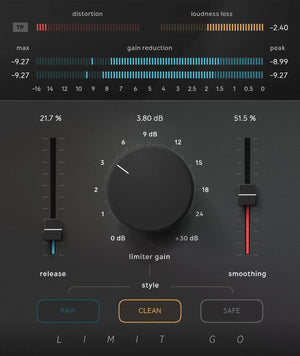
Limit Pro comes with a second plug-in: Limit Go. Limit Go gives you the same limiting capabilities as Limit Pro in a simple, easy-to-use workflow that’s critical when fast results are essential. With three styles loosely based on genres or production styles – Raw, Clean, and Safe – Limit Go offers low latency, low CPU usage, and True Peak processing for mastering, mixes, and single tracks.
Highlights
System Requirements
Supported Processors
Supported Hosts and Formats