Your Cart is Empty




View other products by Make Believe Studios

It sounds good because it is good.
Make Believe Angus 404 is an eight-band graphic EQ plugin from Make Believe Studios and Metric Halo, modeled on the rare Aengus 404 hardware. Based on Rick Carson’s own units at Make Believe Studios, it captures the original’s interacting filters, early breakup and harmonic color, bringing a distinctive rock-and-roll character to guitars and a musical richness to sources throughout your mix.
The Aengus 404
Designed in the 1970s by Steve Crump with input from Bill Riseman, the Aengus 404 brought graphic equalization to the 500-series format before API’s 560. Its tendency to break up earlier than other graphic EQs is central to its sound. Rather than behaving like a set of isolated filters, its bands work together, letting you shape tone and introduce beautiful saturation with bold, musical moves.
Celebrated as a desert-island guitar EQ, the 404 is equally at home adding weight, presence and harmonic richness to other instruments. Use Angus 404 to give a guitar bus its final polish, add body to a snare, reshape a bass part or bring character to a full mix.
Aengus Studios
Aengus began in Massachusetts in the early 1970s, when engineer Bill Riseman and an artist he was working with bought one of the original API company’s last consoles as a set of input modules without a frame, center section or patchbay. With help from an API employee, they completed it and went on to build more consoles, operating a studio upstairs and a console shop downstairs.
Over four years, Aengus built approximately 20 to 30 consoles for studios including Long View Farm and Indigo Ranch in Malibu, where records by Korn and Slipknot were made. Strawberry Studios in the UK installed two 404s in almost every console it built, and the EQ’s devoted users include Sylvia Massy and Ross Hogarth. The video above features Rick Carson telling the story of Aengus Studios and its consoles.
Eight Bands, Built to Be Driven
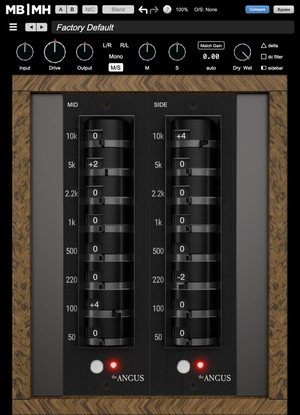
Eight frequency bands cover 50 Hz, 100 Hz, 220 Hz, 500 Hz, 1 kHz, 2.2 kHz, 5 kHz and 10 kHz. Each band offers twelve stepped settings ranging from −12 dB to +15 dB. Angus 404 models the actual response of the hardware, including the overlap and interaction between neighboring bands, rather than treating the markings as exact, independent gain values. The response stays broad at gentle settings and narrows as you boost or cut more aggressively.
The level-compensated Drive control lets you push the saturation harder or back it off while keeping your EQ curve and levels where you set them. Automate Drive to lean into an aggressive passage, then ease back for cleaner lines. Separate Input and Output gain controls, each offering ±24 dB, determine how hard you hit the processor and the level delivered to the next stage in your signal chain.
Mid/Side Processing
On stereo tracks, choose L/R, R/L, Mono or M/S operation. In M/S mode, the mid and side channels each receive their own eight bands, giving you independent tonal control over the center and edges of your mix. Saturation also operates on the mid and side signals, so you can drive the center differently from the stereo information around it.
Highlights
In the Studio
The manufacturer demonstrates Angus 404 in rock and metal mixes, including processing on bass, kick, snare, drums, guitars and vocals, as well as across all tracks. Its combination of stepped controls, interacting bands and controllable saturation is designed for decisive tonal shaping without interrupting your creative flow.
What Engineers Are Saying
“Angus is the first new EQ plugin to make it to my workflow in ages. Loving the results I am getting with it and the sound is undeniable. A must have in the mojo eq toolbox.”
— Mark Lewis
“Just turning this EQ on makes the source sound richer. The 220 Hz frequency is absolute magic on a snare drum; it adds weight and body. I’ve been reaching for the Angus EQ on practically every mix lately. It’s one of those EQs that just makes things sound better.”
— Dan Malsch
“The Angus is the perfect final polish for my guitar tracks and guitar busses. There’s just something about this EQ that gives that added final touch. Don’t sleep on this!!”
— Chris Collier
System Requirements
Licensing Requirements