Your Cart is Empty



View other products by Cherry Audio

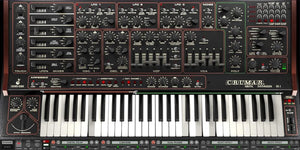
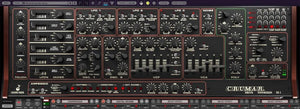
Cherry Audio's Crumar DS-2 synthesizer is a virtual instrument plugin that faithfully recreates the distinctive sonic capabilities of the original 1978 hardware synth. This latest collaboration with Crumar Instruments not only captures the unique tone and multitimbral experience of the original but also enhances it, providing a remarkable blend of innovation and authenticity.
The original Crumar DS-2 featured a monophonic synth engine paired with a 44-note fully polyphonic (paraphonic) companion section, creating a unique musical experience when utilized together. "DS" stood for "Digital Synthesizer," and it was indeed an early hybrid synth with two Digitally-Controlled Oscillators (DCOs), and analog LFOs, VCFs, VCA, and EGs. But these weren't the same kind of DCOs we would become familiar with in later polyphonic synthesizers. To avoid the tuning problems of traditional analog synthesizers, Crumar employed a cutting-edge concept in the Synth section to create oscillators that wouldn’t drift. The resulting waveforms, however, were completely stair-stepped, producing a gritty tone and wild harmonics.
The Poly section was paraphonic, with a single filter (with highpass and lowpass knobs) and its own VCA. It generated unique 'sawtooth' waveforms by combining divide-down square waves with resistors and high-pass filtering. The cutoff, resonance, and modulation settings of the Synth section also applied to the paraphonic poly filter.
As a result, the timbres produced by the DS-2 are distinct from both the smooth, polished sounds of most digital synthesizers and the warm, buttery tones associated with classic analog designs. Instead, the DS-2 has a jagged, harmonically edgy quality and a gritty character that sets it apart.
DS-2 is a true example of "vintage digital" technology, and it's been an exciting journey to revive it in software in collaboration with Crumar Instruments. We've significantly upgraded the DS-2 with a range of innovative features that firmly bring it into the 21st century. The monophonic Synth section has been expanded to include last/high settings, as well as Unison and Multi voice options, offering voice cycling, panning, and tuning capabilities. It also boasts its own polyphonic functionality with 4-, 8-, or 16-voice options. Meanwhile, the Poly section supports full polyphony, accommodating up to 32 notes.
For added versatility, DS-2 features a keyboard split mode in addition to the layered mode, allowing users to assign adjustable ranges for both splits and layers across the Synth and Poly tone generators. OSC 2 in the Synth section now includes a stair-stepped Sine waveform option, and oscillator sync has been added for enhanced sound design possibilities.
A third LFO has been introduced, offering ramp, sine, square, and staircase waveforms. Each LFO now includes discrete delay knobs, replacing the previous global delay knob, and features sync, retrigger, and one-shot capabilities. Reverse wave options are also available for LFOs 1 and 2. The LFO Mixer, which was previously hardwired to specific destinations, now offers six assignable destinations with 33 options each, providing unparalleled modulation flexibility.
The envelopes have been enhanced with an initial delay stage and velocity sensitivity, and now include looping functionality. Additionally, the Poly section now features VCA release control, making it better suited to powerful string-synth sonics. Touch control has been added with four slots and simple click-to-assign functionality, supporting both channel and polyphonic aftertouch with compatible MIDI controllers.
The VCF has been upgraded to include both 12dB 2-pole and the original 24dB 4-pole options, along with polarity and key follow adjustments. Other enhancements include an assignable bend range, a mod wheel, and a dynamic arpeggiator that can be applied to either or both sections.
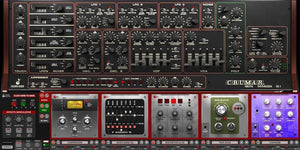
For effects, DS-2 provides three independent customizable effects chains: one for the Synth section, one for the Poly section, and a global layer. Each layer includes an individual effects modulator. Users can choose from 20 studio-quality effects that can be arranged, saved, and recalled within their effects chains. And producers can get started immediately with over 300 professionally designed presets in 14 categories for DS-2 that take full advantage of these features.
DS-2 Features:
System Requirements:
macOS Requirements: macOS 10.13 or above. 64-bit required. Intel or Apple Silicon processor. 3.4 GHz Quad-Core or Apple Silicon CPU with 8GB of RAM recommended. Hard disk space: 150 MB.
Windows Requirements: Windows 7 or above. 64-bit required. 3.4 GHz Quad-Core computer with 8GB of RAM recommended. Hard disk space: 150 MB.
NOTE: Internet connection is required for product activation.