Your Cart is Empty




View other products by Arturia

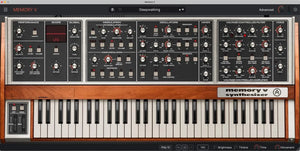
Memory V captures the colossal analogue character and triple-oscillator architecture of the legendary 1982 Memorymoog in exceptional detail. Elevated with advanced drag-and-drop modulation, effects, a four-layer Multi-Arp and expressive keyboard controls, discover a rare polyphonic sound reborn for the modern studio.
Wield phenomenal power
Memory V resurrects the analog majesty of the 1982 Memorymoog with breathtaking authenticity. Build towering brass, dense basses, evolving leads and cinematic pads with the living instability and triple-osc depth of a polyphonic classic - augmented for modern production.
Faithful to the Circuit
Discover the weight, movement and edge of the original hardware, preserved through component-accurate TAE® modelling of its oscillators, filter, mixer, drive and analog non-linearities.
Enhanced for modern production
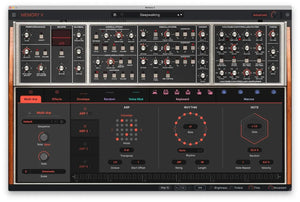
Drag-and-drop modulation, a four-layer Multi-Arp, a 4-slot FX rack, MPE support and Poly 12 voicing extend the Memorymoog into territory the hardware never could reach.
Mix-ready sound library
Explore 300+ presets crafted by Arturia’s sound design team, spanning vintage brass, basses and keys to modern electronic textures, cinematic pads and expressive performance sounds.
Unmatched weight and presence
Hear the dense character of Memory V across genres, from synthwave nostalgia to modern electronic, ambient, R&B and beyond.
A true analog titan
Memory V honours the architecture that defined an era of polyphonic synthesis, and adds the tools you need to push it further.
Triple-oscillator architecture
Three free-running oscillators per voice deliver the harmonic depth that set the Memorymoog apart. Stack Square, Ramp and Triangle waveforms, shape pulse width and sync oscillators for rich, animated sounds.
Legendary ladder filter
The 24 dB low-pass ladder filter that defined the Moog sound, modelled in component-accurate detail. Switch to 12 dB slope, push into self-oscillation, or engage Bass Compensation to preserve the low-end at higher resonance.
Voice modulation depth
Route audio-rate OSC 3 or the Filter Envelope to pitch, pulse width, filter, volume or pan, independently per voice. Chain the envelope into OSC 3 amount for shifting FM-style movement and evolving instability.
Authentic analog feel
Recreate the idiosyncrasy and personality of an OG Memorymoog with Vintage and Dispersion controls. Introduce continuous analog drift, then fine-tune variation across pitch, pulse width, levels, cutoff, emphasis, modulation and envelope times.
Polyphonic power, expanded
Move between the original six-voice architecture and expanded Poly 12 mode. Engage Unison, add detune and spread the result across the stereo field for a dense, immediate sound that fills the mix from a single key press.
Modern modulation and FX
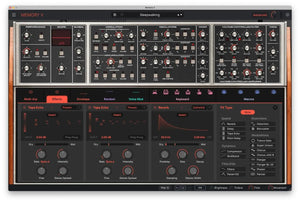
Drag-and-drop modulation, a four-layer Multi-Arp and a 4-slot FX rack with 17+ studio-grade effects bring contemporary sound design into a vintage-inspired architecture without losing its analogue identity.
Zoom In
Zoom in on the panel that earned the Memorymoog its near-mythical status, and the modern enhancements that bring it up-to-spec.
Unleash the roar
Five routes to phenomenal power, all at your fingertips. From screaming sync leads and metallic FM textures to self-oscillating filter menace and unison wall-of-sound.
Included Sounds
Explore 300+ presets that capture the many facets of Memory V, delivering dense front-of-mix polyphonic tone across vintage brass, cinematic pads, saturated basses, evolving textures and more.
Deep Controls
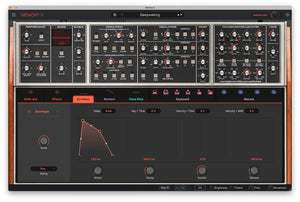
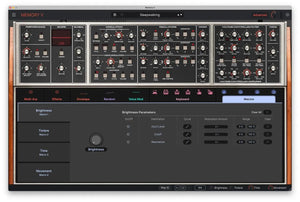
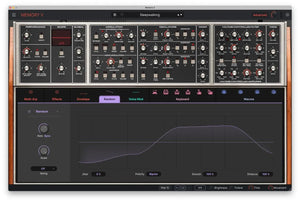
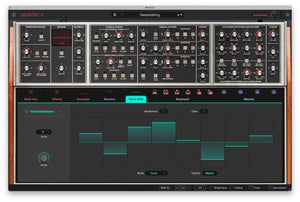
Push the analog character of Memory V into entirely new sonic territory with a creative Advanced panel built for modern workflows.
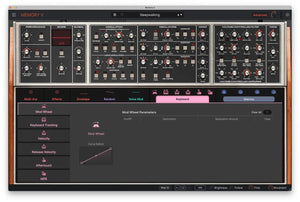
Stack arpeggiator layers, create intricate rhythmic patterns, sculpt sound with drag-and-drop modulation, route MPE and aftertouch to any parameter, and shape your output with four slots of studio-grade effects, all from inside the instrument.
Last of the Moog legends
Released by Moog Music in 1982, the Memorymoog was the company's most ambitious polyphonic statement, and its final polyphonic synth before bankruptcy in 1987. Three oscillators per voice, a ladder filter and a sound that placed it alongside the Prophet-5 and OB-Xa as one of the defining polysynths of its era.
It was conceived as a polyphonic answer to the Minimoog: the same rich tone, opened up for chords, layered brass and wide harmonic movement. In a landscape of more restrained polysynth designs, the Memorymoog pushed toward something more ambitious. The result was a maximalist analog instrument with a reputation for depth, force and unpredictability.
TAE® Powered
The exclusive analog modeling technology that makes our emulations indistinguishable from the originals.
By accurately mimicking the characteristics of analog oscillators, filters, and soft clipping, we can provide astonishing component-accurate detail and authentic analog charm in equal measure.
Main Features
Polyphonic architecture
Classic ladder-filter sound
Voice modulation
Performance and expression
Enhanced analog control
Advanced creative tools
Modern software workflow
Library
Platform specifications
Windows
Apple
Work with ASC
An elegant and simple solution to help you install, activate, and update your Arturia software instruments.
Required configuration
Works in Standalone, VST, AAX, Audio Unit, NKS (64-bit DAWs only).